
Real Estate Marketing Agency: The Complete Guide to Generating High-Quality Property Leads in 2026
Every real estate developer and broker wants more leads. Few actually want more inquiries — because inquiries and leads are not the same thing. A flood of unqualified form-fills that never pick up the phone is worse than no leads at all: it burns your sales team’s time, inflates your cost per acquisition, and makes your marketing spend look ineffective when the real problem is lead quality, not lead volume.
In 2026, the real estate buyer journey has changed dramatically. Buyer behavior has shifted so far online that traditional prospecting methods have become nearly obsolete — cold calling response rates have fallen from around 12% in 2010 to roughly 3% today. At the same time, a growing share of homebuyers now start their research using AI tools like ChatGPT and Google’s AI Overviews instead of typing directly into search engines or property portals.
This guide breaks down exactly how a modern real estate marketing agency builds a lead engine that adapts to these shifts — and how you can apply the same playbook, whether you’re a developer launching a project or a broker building your personal pipeline.
Why “More Leads” Isn’t the Goal — Qualified Leads Are
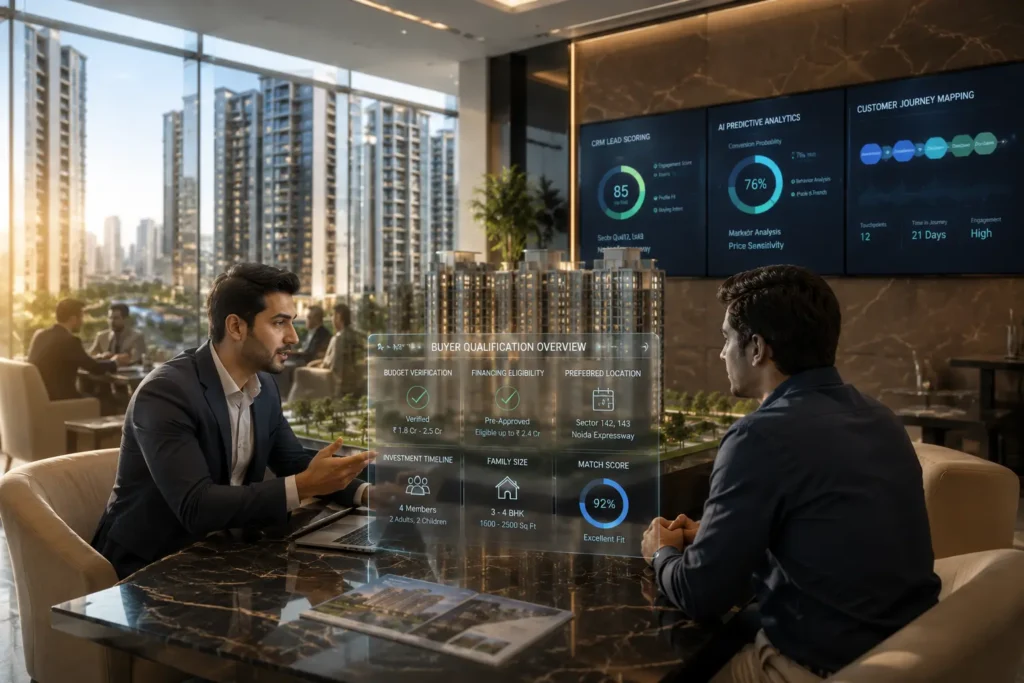
Before diving into channels, it’s worth resetting the definition of success. A high-quality property lead is someone who:
- Has the budget or financing capacity for the specific project or price bracket
- Is actively searching within a realistic timeline (not “just browsing”)
- Matches the location, unit type, or investment profile you’re actually selling
- Has provided accurate, reachable contact information
Everything below is built around filtering for these four traits at each stage of the funnel, rather than simply maximizing form submissions.
1. A Conversion-Ready Website Is Non-Negotiable
Your website is still the foundation every other channel points back to. In 2026, that means:
- Mobile-first design. The overwhelming majority of property searches now begin on a phone, so page speed and thumb-friendly navigation directly affect whether a visitor converts or bounces.
- Project-specific landing pages. A single generic “Contact Us” page cannot convert traffic from ten different Google Ads campaigns. Each project, location, or unit type needs its own landing page with matching messaging, pricing transparency, and a clear next step.
- Instant lead capture. WhatsApp click-to-chat buttons, callback request widgets, and AI chatbots that qualify visitors 24/7 all reduce the drop-off between interest and inquiry.
- Trust signals. RERA registration details, approvals, construction-progress photos or webcams, and genuine client testimonials matter more for real estate than almost any other category, given the size of the financial commitment.
2. Performance Marketing: Google Ads and Meta Ads
Paid media remains the fastest way to generate volume, but the strategy differs sharply by platform and intent.
Google Ads (Search + Performance Max) captures high-intent buyers who are actively searching — “3 BHK flats in [location],” “commercial shops near [landmark],” or “farmhouse plots for sale.” These clicks convert faster because the buyer is already in research or decision mode. The tradeoff is cost per click, which keeps climbing in competitive real estate markets, making tight keyword match types and negative keyword lists essential to avoid wasting spend on browsers and job-seekers.
Meta Ads (Facebook + Instagram) work differently — they interrupt rather than capture, using interest and lookalike targeting to put a project in front of people who haven’t started searching yet but fit the buyer profile. This channel is particularly strong for:
- Retargeting website visitors who didn’t convert
- Lookalike audiences built from your existing buyer or investor database
- Video-led ad creative, since video listings generate dramatically more inquiries than static image posts alone
Combining both channels typically outperforms relying on either alone — Google captures demand, Meta creates it. Industry benchmarks now put blended SEO-plus-paid strategies at the top of the ROI table for exactly this reason.
3. SEO for Real Estate: Playing the Long Game
Paid ads generate leads today; SEO generates leads for years without a per-click cost. For real estate specifically, SEO strategy should prioritize:
- Hyperlocal content — location-specific pages, area guides, and “best societies/localities in [city]” content that captures long-tail search intent
- Project and developer pages optimized around the exact terms buyers search (unit configurations, price ranges, possession dates)
- AI-search optimization — with a growing share of research now happening inside AI chat tools rather than traditional search results, structuring content with clear facts, FAQs, and schema markup helps your listings get surfaced when AI assistants summarize answers, not just when someone scrolls a results page
- Google Business Profile optimization, since local searches convert into a call, message, or site visit within a day at a very high rate

4. Video and Visual Content
Photography and video are no longer “nice to have.” Listings with video draw a dramatically higher volume of inquiries than those without, and 3D virtual tours meaningfully speed up buyer decision-making by letting serious prospects self-qualify before ever contacting sales. For developers, this means budgeting for:
- Drone footage of the site and surrounding infrastructure
- Walkthrough videos of sample flats or show units
- Short-form vertical video (Reels/YouTube Shorts) for social distribution
- AI-assisted virtual staging for under-construction or unfurnished units
5. WhatsApp and CRM-Driven Follow-Up
Generating the lead is only half the job — the speed and structure of follow-up determines whether it converts. A CRM that automatically:
- Assigns leads to the right sales executive within minutes
- Triggers WhatsApp and email drip sequences
- Scores leads based on engagement (site visit requested vs. brochure download)
- Flags stale leads for re-engagement campaigns
…will consistently outperform a team relying on spreadsheets and manual follow-up, regardless of how much is spent on ads upstream.
6. Outdoor Advertising (OOH) — Still Relevant, Now Trackable
For large residential and commercial launches, digital alone often isn’t enough to build the local trust and top-of-mind awareness a big-ticket purchase requires. Strategically placed billboards near high-traffic routes, combined with QR codes or trackable landing page URLs, let developers build brand presence while still measuring the digital leads OOH drives — bridging the gap between offline visibility and online attribution.
7. Email and Retargeting — The Overlooked Multiplier
Buyers rarely convert on the first visit; the median property search stretches over several weeks. Email nurture sequences and retargeting ads keep your project visible during that entire consideration window, and email in particular continues to convert notably better than social media for real estate lead nurturing when used consistently.
Building the Full-Funnel System
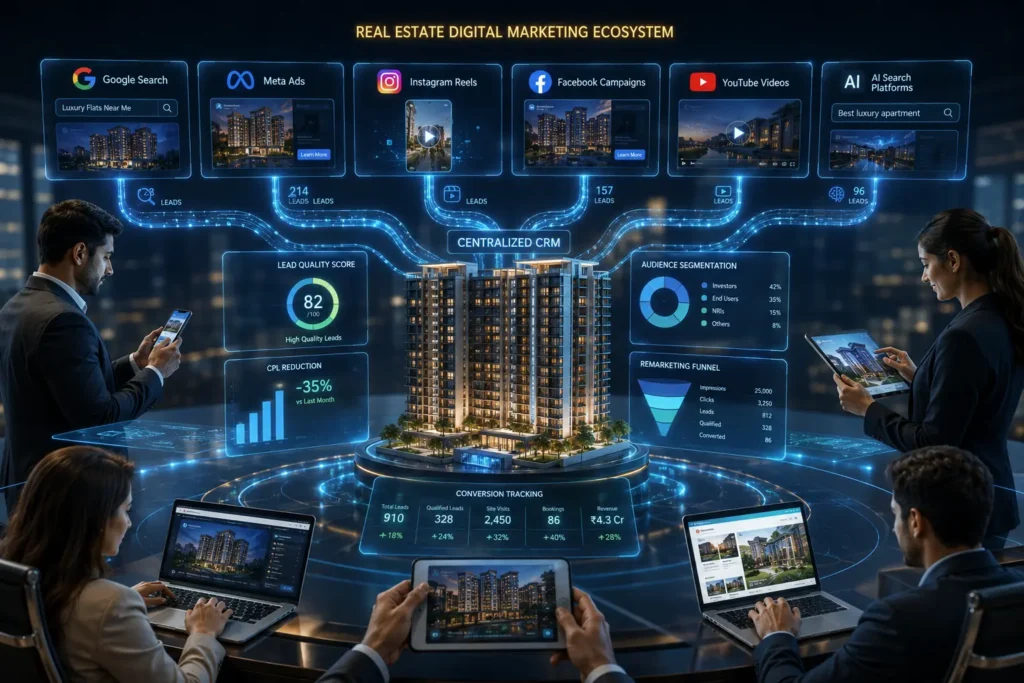
A real estate marketing agency’s real value isn’t any single tactic above — it’s the system connecting them:
- Awareness: Meta Ads, video content, OOH branding build visibility
- Consideration: Google Ads, SEO, and landing pages capture active search intent
- Conversion: Instant response via WhatsApp/chatbot, fast CRM follow-up
- Nurture: Email and retargeting keep slow-moving buyers warm
- Close: Sales-ready leads handed off with full context — source, budget, timeline
Agencies that only run ads without owning this full loop tend to generate volume without quality. Agencies that build the entire system — website, paid, SEO, content, and CRM follow-up working together — are the ones consistently producing leads that convert to site visits and bookings.
Final Thoughts
The tools available for real estate marketing in 2026 — AI-assisted targeting, predictive analytics, AI search optimization, automated follow-up — are more powerful than ever. But they only work inside a properly built system. Random ad spend on a slow, generic website will always underperform a coordinated strategy built around a specific project, audience, and funnel.
Yosh Marcom works as a full-service partner for real estate developers and brokers — handling performance marketing, SEO, website development, video/content production, and outdoor advertising under one roof, so every channel feeds the same lead pipeline instead of operating in isolation.
Looking to fix your lead quality, not just your lead count? Get in touch with Yosh Marcom for a free marketing audit of your current campaigns.